The Humanoid Robot Games, held in Beijing, China, marked a groundbreaking moment in robotics, as the world’s first sports event for humanoid robots unfolded with equal parts innovation and chaos.
Hosted as part of the 2025 Beijing International Artificial Intelligence Expo, the event drew 26 teams from universities, research institutes, and tech companies, showcasing robots competing in soccer, sprinting, kickboxing, and more.
Robots are now winning races… and taking out humans on the track.
China just hosted the first ever World Humanoid Robot Games, with 500 robots from 16 countries competing. The 1,500M champion, the Unitree H1, set a record and accidentally plowed into a staff member mid-run. pic.twitter.com/g1fb2LdX8x
— Cheddar (@cheddar) August 15, 2025
While the Humanoid Robot Games aimed to highlight advancements in AI and robotics, the frequent stumbles and crashes of these mechanical athletes became the unexpected highlight, revealing both the promise and limitations of humanoid robotics [Reuters, The Guardian].
Meanwhile, China hosts World Humanoid ROBOT Games
One tumbles down stairs — HEAD rolls, it ‘DIES’
Tickets cost $18–$81
World’s first accidental robot ‘death’? pic.twitter.com/CkW0Jt9HsY
— RT (@RT_com) August 16, 2025
The Humanoid Robot Games featured nine categories, including track races, soccer matches, and combat-style events, with robots ranging from sleek, human-like designs to clunky, utilitarian models.
Some robots executed impressive feats, such as backflips and precise kicks, demonstrating strides in balance and coordination [The Indian Express]. For instance, a robot from the Beijing Humanoid Robot Innovation Center managed a flawless backflip, earning cheers from the crowd.
You May Also Like:
AI-Created Books Spark Alarming Warning from Publishers Over Sports Autobiography Imitations
Google will announce the biggest Android upgrade of the year this week
However, these moments of brilliance were often overshadowed by robots colliding, toppling over hurdles, or freezing mid-motion, underscoring the challenges of mimicking human agility [CNN].
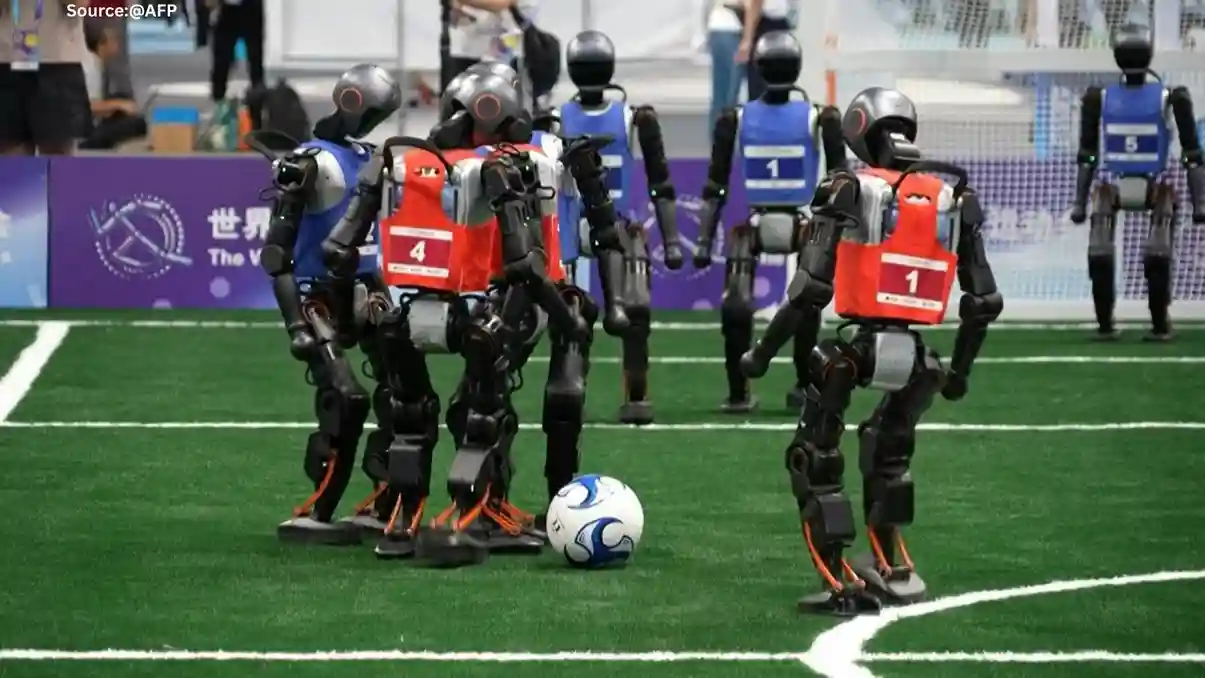
The soccer matches, a crowd favorite, were particularly chaotic. Robots frequently misjudged passes, tripped over the ball, or collapsed while attempting to kick, leading to moments of unintended comedy.
“It’s like watching toddlers play football,” one spectator remarked, as reported by Live Science. Yet, these fumbles highlighted the complexity of programming robots to navigate dynamic environments, a key focus of the Humanoid Robot Games [DW].
The frequent falls at the Humanoid Robot Games were not just amusing—they revealed critical gaps in current robotic technology. Engineers noted that maintaining balance on uneven surfaces or during rapid movements remains a significant hurdle.
“These robots are pushing the boundaries, but they’re not quite ready to replace human athletes,” said a researcher from Tsinghua University, quoted by [NBC News].
The games underscored the need for advancements in real-time processing, sensor accuracy, and adaptive algorithms to handle unpredictable scenarios [The New York Times].
Despite the mishaps, the event was a testament to China’s growing dominance in AI and robotics. The Humanoid Robot Games were part of a broader push to integrate AI into industries, from manufacturing to healthcare, aligning with China’s ambition to lead global AI innovation by 2030 [BBC].
The spectacle also drew comparisons to the early days of human sports, where trial and error paved the way for progress Mashable.
The Humanoid Robot Games weren’t just a quirky experiment—they signaled a future where robots could assist in tasks requiring human-like dexterity, from disaster response to elderly care. However, the frequent tumbles highlighted that such applications are still years away.
“Every fall is a lesson,” said an organizer from the Beijing AI Expo, as reported by [India Today].
The event also sparked discussions about the ethical and practical implications of humanoid robots, with some critics questioning whether the focus on human-like machines distracts from more practical robotic designs RADII.
Spectators and analysts alike were captivated by the blend of ambition and imperfection. The games offered a glimpse into a future where robots might compete alongside humans—or even surpass them—but for now, the Humanoid Robot Games were a humbling reminder of how far the technology has yet to go [Times of India].
Disclaimer: Some details in this report are based on unverified sources and should be treated with caution. Information has been synthesized from reputable outlets, with attribution provided.