President’s demand intensifies scrutiny on chip giant’s leadership amid national security concerns
U.S. President Donald Trump has demanded the immediate resignation of Intel’s new CEO, Lip-Bu Tan, citing “significant conflicts” due to his investments in Chinese firms, raising questions about the future of the American semiconductor leader.
U.S. President Donald Trump on Thursday demanded the immediate resignation of Intel’s new CEO, Lip-Bu Tan, labeling him “highly conflicted” due to his extensive ties to Chinese companies, casting doubt on his ability to lead the struggling U.S. chipmaker’s turnaround.
Trump’s Demand
Conflict of Interest Allegations
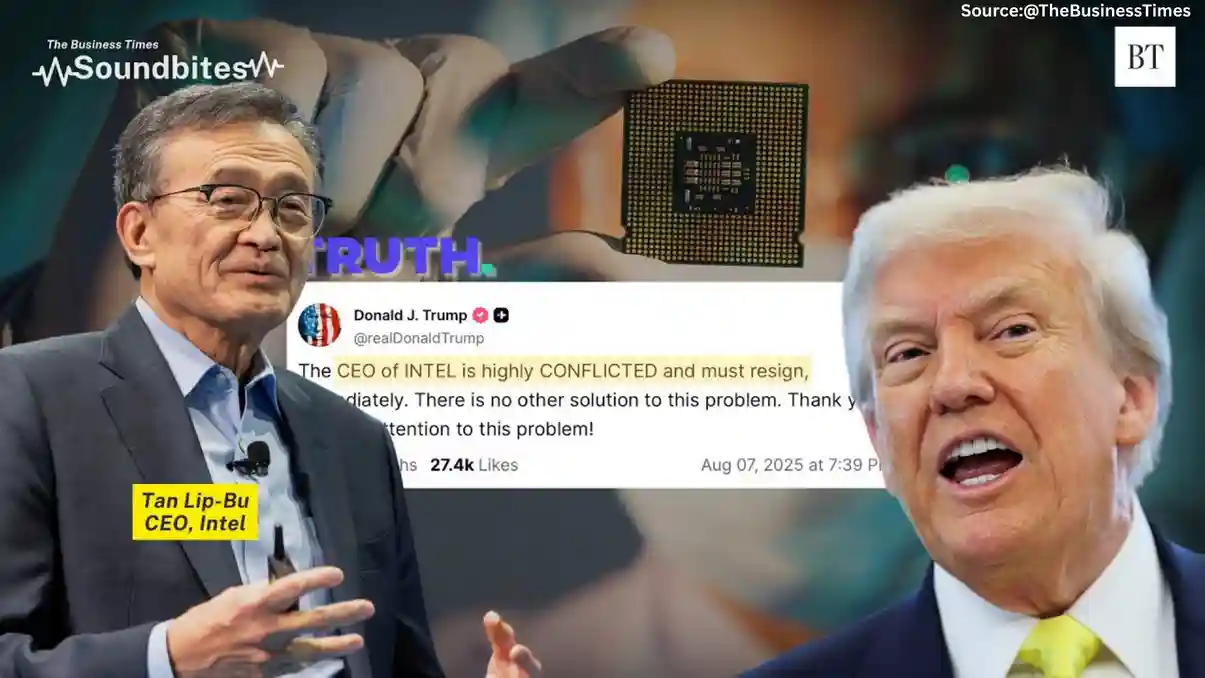
Trump’s call for Tan’s resignation came via a post on his Truth Social platform, where he stated, “The CEO of INTEL is highly CONFLICTED and must resign, immediately.
There is no other solution to this problem.” The demand followed a Reuters report on Wednesday highlighting a letter from Republican Senator Tom Cotton to Intel’s board chair, Frank Yeary, questioning Tan’s connections to Chinese firms and a recent criminal case involving his former company, Cadence Design Systems.
Reuters had previously reported in April that Tan, either personally or through venture funds he founded or operates, invested at least $200 million in hundreds of Chinese advanced manufacturing and chip companies, some linked to the Chinese military.
You may Also Like to read:
Trump Nvidia, AMD China chip revenue deal implications
Intel stock soars amid talks of potential US government investment
iPhone 17 looms: What’s next for Apple’s smartphone lineup
Trump demands Intel CEO Lip-Bu Tan ‘resign immediately’ amid alleged ties to Chinese military trump pic.twitter
— New York Post (@nypost) August 7, 2025
Political and Market Reaction
Trump’s intervention, a rare instance of a U.S. president publicly demanding a corporate CEO’s resignation, sent Intel’s shares down 3% on Thursday. Investors and analysts expressed mixed views.
“It sets a troubling precedent for presidents to dictate corporate leadership, though Trump’s concerns carry weight,” said Phil Blancato, CEO of Ladenburg Thalmann Asset Management. David Wagner of Aptus Capital Advisors, an Intel shareholder, noted, “While some see Trump overstepping, it signals his commitment to prioritizing U.S. business interests.”
Trump & ex-Intel board members want CEO Lip-Bu Tan out—citing China ties—plus a chip-making spin-off.#Intel #TrumpNews #TechPolitics #ChipWar #BreakingNews #USChina #Semiconductors pic.twitter.com/NwDUP2x8dc
— Bilbies INGENIOUS (@BilbiesINGENIO1) August 11, 2025
Intel’s Challenges
National Security Implications
Intel is a cornerstone of U.S. efforts to bolster domestic semiconductor production, securing $8 billion in subsidies under the 2022 CHIPS Act to build factories in Ohio and other states.
A leadership change could disrupt these plans, especially amid concerns about Tan’s investments in Chinese firms tied to the People’s Liberation Army, as identified by Reuters through Chinese corporate databases and U.S. analyst lists.
A source told Reuters in April that Tan had divested some of these holdings, but the extent remains unclear, with many investments listed as current in Chinese records.
Corporate Response
Intel issued a statement affirming that Tan, its board, and the company are “deeply committed to advancing U.S. national and economic security interests” and are making significant investments aligned with Trump’s “America First” agenda.
Tan, who assumed the CEO role in March 2025, did not directly respond to Reuters’ requests for comment but emphasized his commitment in a company statement.
“My reputation is built on trust and doing things the right way,” Tan said, noting ongoing engagement with the administration to address concerns.
Background on Tan’s Ties
Investment History
Reuters’ April investigation revealed that between March 2012 and December 2024, Tan invested in Chinese firms, including contractors and suppliers for the Chinese military, through his venture capital firm, Walden International, and other funds.
Twenty of these investments involved joint ownership with Chinese government funds or state-owned enterprises in tech hubs like Hangzhou and Hefei.
Tan’s tenure as CEO of Cadence Design Systems from 2008 to 2021 also came under scrutiny, as the company sold products to a Chinese military university linked to nuclear explosion simulations, leading to a $140 million settlement in 2025 to resolve U.S. charges.
Analyst Perspectives
Bernstein analyst Stacy Rasgon argued that Tan is not inherently “conflicted” but acknowledged that his China ties create an unfavorable perception under the current administration. “Unlike some tech CEOs, Tan lacks a personal rapport with Trump, which could mitigate this pressure,” Rasgon noted. A White House official underscored Trump’s focus on national security, stating, “The President is committed to ensuring iconic U.S. companies are led by trustworthy individuals.”
Industry Context
Intel’s Struggles
Once a titan of Silicon Valley, Intel has lost its manufacturing edge to Taiwan’s TSMC and has minimal presence in the booming AI chip market dominated by Nvidia.
Its stock has remained flat in 2025 after a 60% drop in 2024, with its market value now below $100 billion, compared to Nvidia’s $4 trillion.
Tan’s predecessor, Pat Gelsinger, was ousted in December 2024 after failing to meet ambitious manufacturing and AI goals, as reported by Reuters.
Tan has since scaled back global factory plans and reduced Intel’s workforce by 22% to 75,000, aiming to restore profitability.
Ohio Factory Delays
Intel’s Ohio factory, a key part of its CHIPS Act-funded expansion, faces delays, with completion now projected for 2030 or 2031.
Ohio Senator Bernie Moreno suggested on X that Intel’s failure to meet commitments warrants a fraud investigation (), reflecting growing frustration with the company’s progress. The production process for high-end chips also faces quality challenges, further complicating Intel’s turnaround efforts.
Source: This article is based on a report by Aditya Soni, published by Reuters on August 7, 2025, updated August 8, 2025. Additional context was drawn from posts on X discussing Trump’s demand and Intel’s challenges.