Revenue-sharing agreement with U.S. sparks debate over market access and national security
Key Points
-
Nvidia and AMD will pay the U.S. government 15% of their China chip sales revenue to secure export licenses, the White House confirmed.
-
Analysts view the deal as a win for both companies, granting access to China’s vast market despite the levy.
-
The unconventional arrangement, described as a “tax” by some, raises questions about future U.S. trade policies.
The White House has confirmed a groundbreaking deal requiring Nvidia and AMD to share 15% of their revenue from AI chip sales to China with the U.S. government, a move that unlocks access to a lucrative market but stirs debate over its long-term implications for global trade and technology.
Deal Details
Revenue-Sharing Agreement
Nvidia and AMD have agreed to remit 15% of their earnings from China-specific AI chips—Nvidia’s H20 and AMD’s Instinct MI308—to the U.S. government in exchange for export licenses, as reported by the Financial Times.
The arrangement, finalized after negotiations with President Donald Trump, allows both companies to resume sales previously restricted by national security concerns. “We comply with U.S. regulations to compete globally,” Nvidia told NBC News, emphasizing its commitment to market participation.
Trump’s Negotiation Tactics
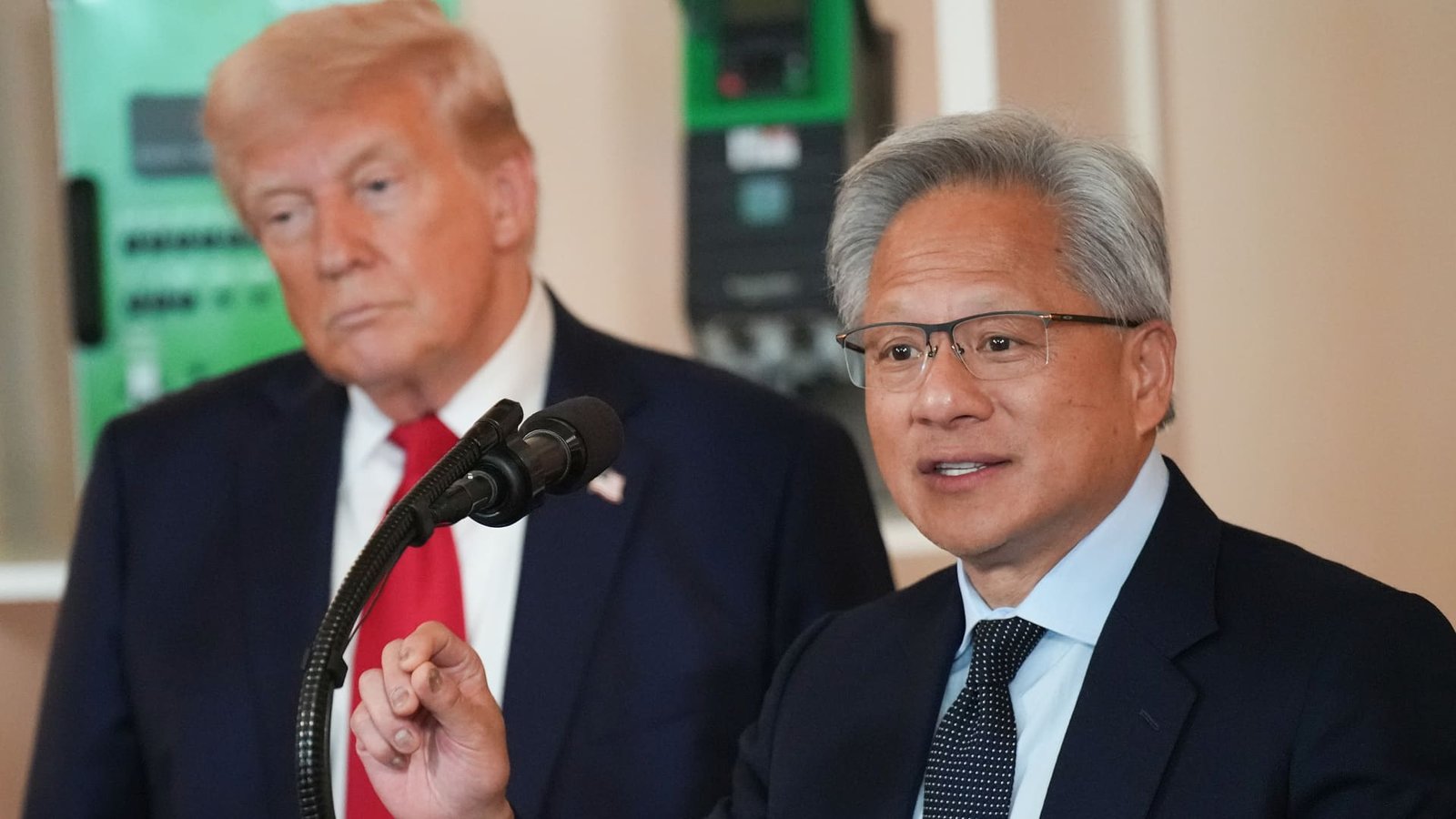
President Trump, known for his deal-making approach, initially sought a 20% cut from Nvidia, as he revealed in a Monday press conference, but settled at 15% after discussions with CEO Jensen Huang. “This is about putting America first,” Trump stated, framing the deal as a financial win for the U.S. The White House described the arrangement as a strategic move to balance economic interests with security imperatives.
You May Also Like:
Crypto fugitive pleads guilty to $40bn fraud
Musk and Altman’s AI Rivalry Ignites Public Spat on X
Market Impact
Positive for Chipmakers
Analysts see the deal as a net positive for Nvidia and AMD, restoring access to China’s massive AI market. “Eighty-five percent of something is better than nothing,” said Ben Barringer, global technology analyst at Quilter Cheviot.
Both companies’ shares dipped slightly on Monday, reflecting investor caution, but the potential for billions in sales—Nvidia projected $8 billion in H20 sales for the July quarter—underscored the deal’s value. However, Barringer noted uncertainty about whether the firms might raise prices to offset the 15% levy.
Competitive Landscape
The agreement prevents Nvidia and AMD from ceding market share to Chinese rival Huawei, which produces a similar chip.
“Without this deal, Huawei could dominate,” Barringer told CNBC. Yet, George Chen of The Asia Group warned that growing U.S. demands for larger revenue cuts could complicate future sales if China’s market expands, highlighting long-term risks for both companies.
Policy Implications
Unusual Trade Strategy
Analysts described the revenue-sharing model as “unusual,” likening it to an “indirect tariff” or “pay-to-play” tactic. “This is classic Trump—yielding only if he gets something in return,” said Barringer, noting its alignment with the president’s transactional style.
Daniel Newman of The Futurum Group called it a “tax” for doing business in China, raising concerns about its scalability to other sectors. “Semiconductors are strategic, so this may not extend to software or services,” said Nick Patience of The Futurum Group.
National Security Concerns
The U.S. restricts AI chip exports to China to prevent advancements in Chinese military AI capabilities. Trump dismissed Nvidia’s H20 as “obsolete,” comparing it to the advanced Blackwell chip, which he would not allow for export without significant downgrades.
However, Jensen Huang argued that U.S. chip sales to China bolster national security by keeping Chinese AI developers reliant on American technology, a view contested by critics citing risks of technology transfer.
Global Reactions
China’s Response
China has expressed mixed sentiments. While local firms need U.S. chips to advance AI ambitions, the 15% levy increases costs, and concerns about potential U.S. “backdoors” in chips persist, as noted by China’s Global Times.
Recent Chinese regulatory scrutiny of Nvidia’s chips for security vulnerabilities, reported by the Financial Times, reflects heightened tensions. “China wants these chips but distrusts the terms,” said Neil Shah of Counterpoint Research.
Geopolitical Context
The deal aligns with Trump’s broader trade policies, including a 100% tariff on non-U.S. chip imports () and negotiations to extend a U.S.-China tariff truce (). Posts on X reveal polarized views, with some praising the revenue boost for the U.S. and others criticizing it as a risky precedent ().
The arrangement echoes other 2025 tech disputes, such as Trump’s call for Intel’s CEO resignation over China ties (), underscoring a pattern of assertive U.S. trade strategies.
This article is based on a report by Arjun Kharpal, published by CNBC on August 11, 2025, updated at 4:13 p.m. EDT. Additional context was drawn from posts on X discussing the deal and U.S. trade policies.